
Don’t Play Dead When Looking for an Alabama Service Dog Trainer
Why Finding the Right Alabama Service Dog Trainer Changes Everything
Finding a qualified Alabama service dog trainer is one of the most important decisions a person with a disability — or their family — will ever make. The right trainer does more than teach commands. They help build a dependable working partnership between handler and dog that can hold up in real life, from a busy Huntsville grocery store to a crowded waiting room in Madison.
Here are a few important things to know before you begin:
Not every dog qualifies. Research suggests only about 1 in 1,000 shelter dogs has the temperament needed for service work.
Training takes time. Most dogs need 50 or more lessons before they are ready for advanced public access work.
Owner-trained dogs are legal. Under the ADA, you can train your own dog with professional guidance, and that path is often far more affordable than getting a fully trained dog from a program.
No federal certification exists. Online registries offering “official” service dog certificates are not recognized under the law.
The stakes are real. A service dog can support greater confidence, safety, and independence, but that kind of partnership does not happen by accident. It starts with choosing a trainer who understands service work, communicates clearly, and uses a calm, handler-led process.
In Huntsville and across North Alabama, more families are exploring service dog training for PTSD, mobility challenges, seizure response, autism support, and other disability-related needs. Understanding how the process works — and what to look for in a trainer — is the first step.
Understanding the Role of an Alabama Service Dog Trainer
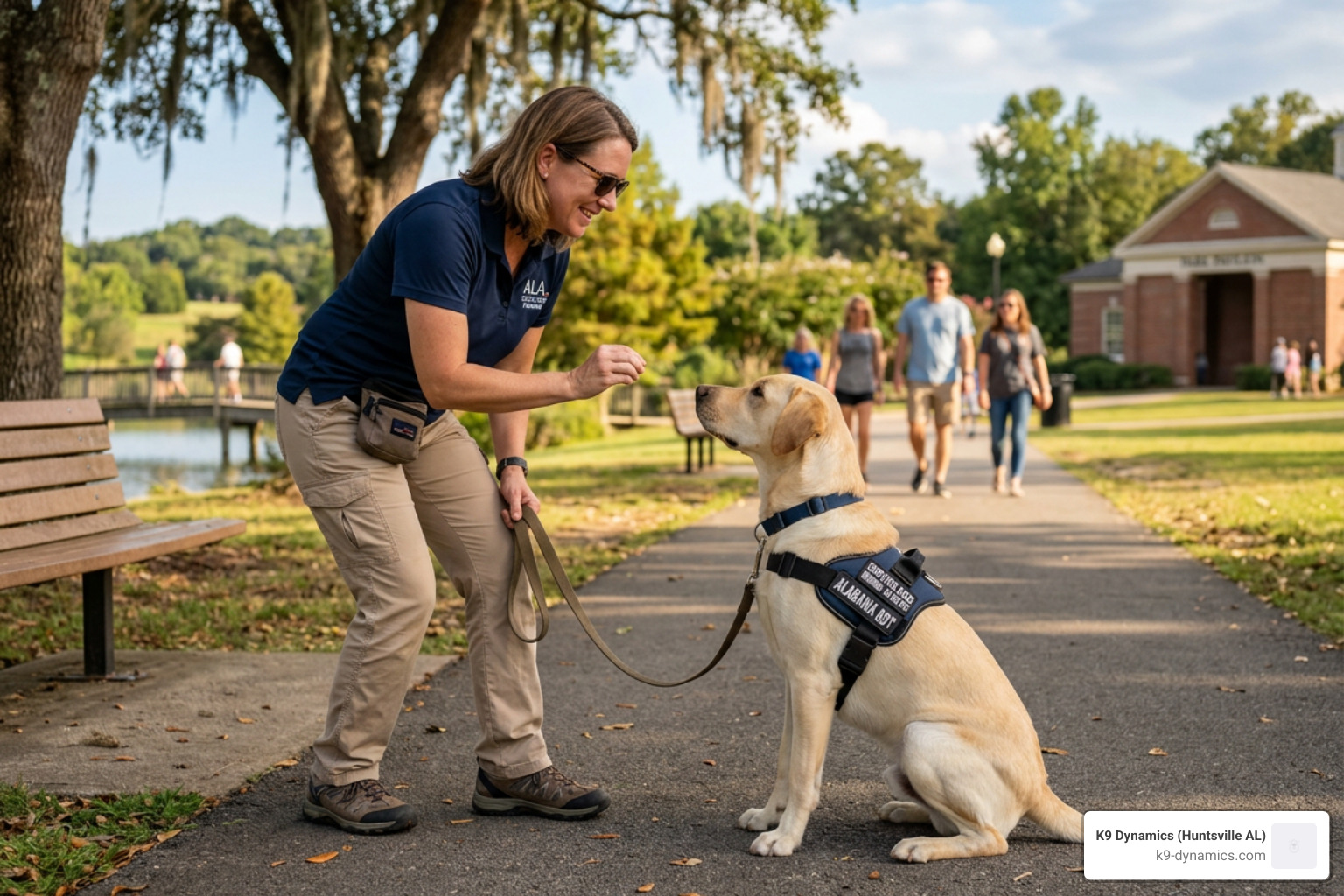
When you begin your search for an Alabama service dog trainer, it is essential to understand that service dog work is vastly different from standard pet obedience. At Huntsville Dog Training, the philosophy is clear: a service dog must be more than just “well-behaved”—they must be a reliable extension of their handler. This requires a specialized approach centered on clear communication and consistent focus.
At Huntsville Dog Training, the method is based on proactive guidance. Rather than waiting for a dog to make mistakes or relying heavily on food rewards, the focus is on teaching dogs to follow the handler’s lead through movement and body language.
This approach uses remote touch via an e-collar strictly as a communication tool—a subtle cue to guide attention back to the handler. The result is off-leash reliability and confidence, which is critical when navigating busy environments like Bridge Street Town Centre or medical facilities in Madison.
A strong foundation, often aligned with Canine Good Citizen principles, ensures the dog has the baseline behavior required before progressing into advanced service work.
 Why Your Alabama Service Dog Trainer Focuses on Habit Reversal
Many dogs begin training with habits that are incompatible with service work—sniffing, jumping, or becoming easily distracted. At Huntsville Dog Training, the focus is on structured habit reversal.
Instead of relying on treats or toys, which can introduce distractions in real-world scenarios, training emphasizes handler-led movement and a foundational concept known as the “sit anchor.” This teaches the dog to hold position until given a new direction, reinforcing calm, predictable behavior.
In environments like Madison retail stores or office spaces, this level of consistency is essential. Over time, repetition and clear communication transform guided behavior into automatic habit.
Distinguishing Service Dogs from Therapy and ESA Animals
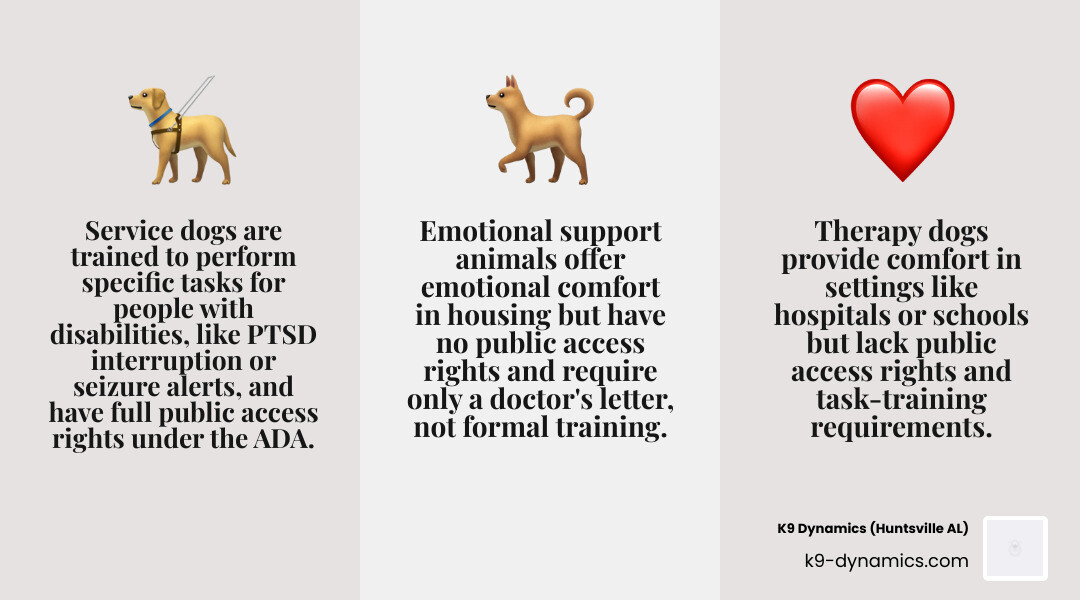
There is frequent confusion around the differences between service dogs, therapy dogs, and emotional support animals:
Service Dogs: Individually trained to perform specific tasks related to a disability. They have full public access rights under the ADA.
Therapy Dogs: Provide comfort in structured environments like hospitals or schools but do not have public access rights.
Emotional Support Animals (ESAs): Provide comfort through presence alone and are protected under housing laws, not public access laws.
A true Alabama service dog trainer focuses specifically on the rigorous standards required for service dogs.
Specialized Service Dog Tasks and Disability Support
Service dogs are trained for highly specific tasks based on individual needs.
Psychiatric and PTSD support may include:
- Deep Pressure Therapy
- Nightmare interruption
- Anxiety alerts
- Room searches
Mobility and medical support may include:
- Balance assistance and retrieval tasks
- Seizure response
- Diabetic alerts
- Allergen detection
These capabilities are built through structured, consistent training tailored to the handler.
The Path to Public Access: Process and Timelines
Training a service dog is a long-term commitment. Most programs require 50+ professional sessions, often spanning 18–24 months for a fully trained dog.
Owner-trained models with professional guidance typically range from $4,000 to $8,000, while fully trained program dogs can exceed $40,000.
At Huntsville Dog Training, the process begins with evaluating the dog’s temperament and focus, ensuring suitability before progressing.
Evaluating an Alabama Service Dog Trainer in Huntsville
Choosing the right trainer requires transparency and experience. Huntsville Dog Training emphasizes honest evaluations and a hands-on, handler-involved approach.
Dogs must demonstrate neutrality—not overly reactive or fearful—to succeed in service work. This early evaluation stage is critical for long-term success.
Preparing for the Public Access Test
Many programs use the Public Access Test (PAT) to confirm reliability in real-world environments.
Training involves practicing in public settings, ensuring the dog maintains focus despite distractions like food, crowds, or other animals. The “sit anchor” remains a key benchmark of control and consistency.
Legal Rights and Public Access Rules in Alabama
Under the ADA, service dogs are allowed in most public spaces. Businesses may only ask two questions:
- Is the dog required because of a disability?
- What task is the dog trained to perform?
They cannot request documentation or certification.
Handlers must maintain control of their dogs at all times. Disruptive behavior can result in removal, reinforcing the importance of proper training.
Frequently Asked Questions
How much does service dog training cost?
Typically $2,000–$8,000 for owner-trained programs with professional support.
Can I train my own service dog?
Yes, but professional guidance is strongly recommended.
How long does training take?
Usually 18–24 months, depending on the dog and required tasks. Ask at Huntsville Dog Training how we train differently!
The journey to building a reliable service dog partnership requires structure, patience, and the right guidance. Huntsville Dog Training provides a handler-led approach focused on proactive communication, habit development, and real-world reliability.
Whether you are starting from scratch or refining an existing dog’s skills, choosing the right trainer is the foundation for long-term success.