

Why an E-Collar Is One of the Most Misunderstood Tools for Family Dogs
E collar family dog training is simpler — and more humane — than most people think. If your dog ignores you at the park, pulls on the leash through your Madison neighborhood, or just won’t come when called, a properly used e-collar can change that fast.
Here’s a quick answer to what most owners want to know:
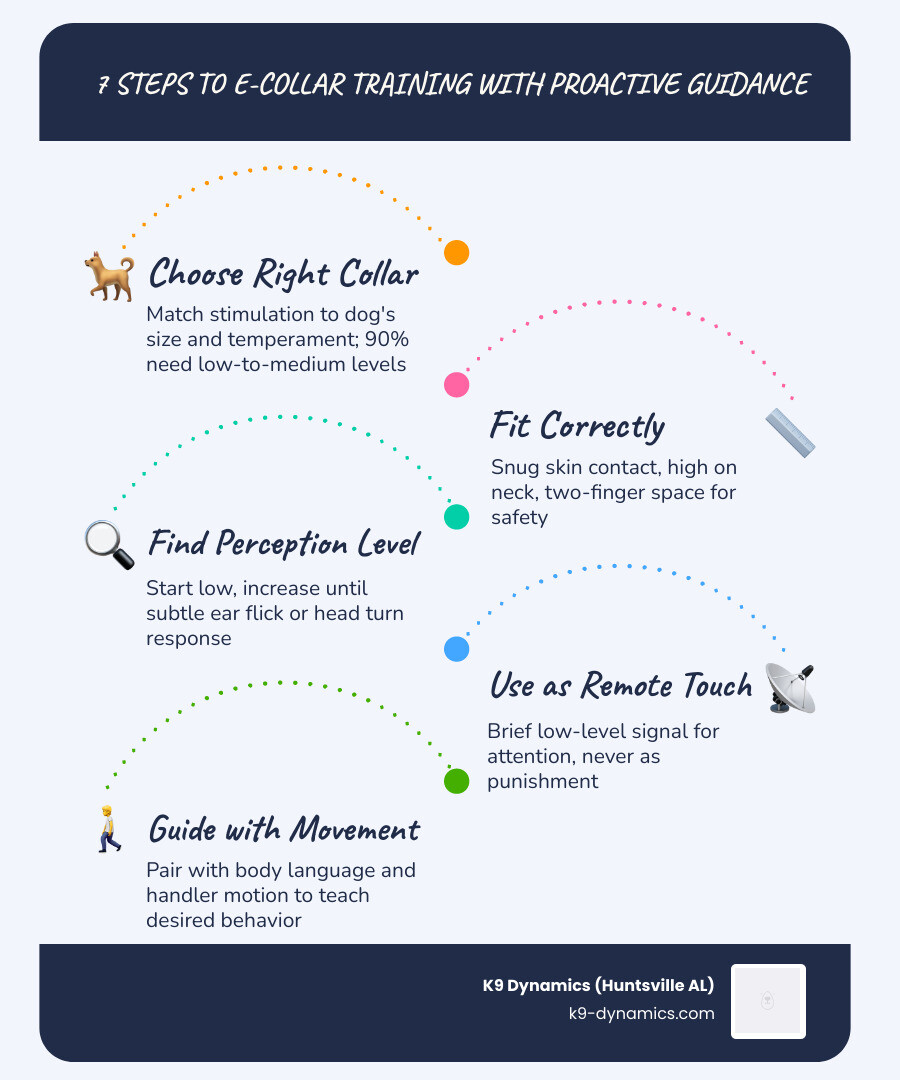
How to use an e-collar for a family dog:
- Choose the right collar – Match stimulation power to your dog’s size and temperament (90% of dogs need only low-to-medium power)
- Fit it correctly – Snug contact with skin, two fingers of space, worn high on the neck
- Find the perception level – Start at the lowest setting and increase slowly until you see a subtle response (ear flick, head turn)
- Use remote touch as communication – A brief, low-level signal gets your dog’s attention — it is not a punishment
- Guide the behavior – Use handler movement and body language alongside the remote touch to show your dog what you want
- Keep sessions short – 10 to 15 minutes daily is more effective than long, infrequent sessions
- Build reliable habits – Practice in real environments like Big Spring Park or your backyard until the response is automatic
Here in Huntsville, AL, we call this approach proactive guidance. The e-collar is a communication tool focused on clarity. Think of it like a gentle tap on the shoulder — a way to reach your dog when your voice can’t compete with a squirrel, another dog, or a busy trail on Monte Sano.
Most owners are surprised to learn that at the correct level, the sensation is so subtle the dog barely reacts. That’s exactly the point.
This guide walks you through everything — from choosing the right collar to building a reliable sit anchor — so you and your dog can move through the world as a confident team.
Understanding the e collar family dog
When we talk about an e collar family dog, we aren’t talking about the “shock collars” of the 1970s. Modern technology has completely transformed these tools into sophisticated communication devices. Today’s high-quality e-collars use “wide-pulse” stimulation, which is the same technology used in physical therapy TENS units for humans. It interacts with the muscle rather than the skin, creating a sensation that is more of a “tap” or a “tickle” than a sharp sting.
For families in North Alabama, from the quiet suburbs of Madison to the farm-heavy areas of Harvest and Toney, the e-collar provides a layer of safety that a standard leash simply cannot. It allows your dog to enjoy the freedom of off-leash play while ensuring they remain responsive to your guidance.
A 2024 e collar study titled “Comparison of the Efficacy and Welfare of Different Training Methods in Stopping Chasing Behavior in Dogs” recently highlighted how effective these tools can be. The study found that e-collar training significantly reduced dangerous chasing behaviors in a very short timeframe — often within five days — without compromising the dog’s overall welfare when used correctly. For a family dog in Huntsville, this means the difference between a dangerous run toward a car on Memorial Parkway and a safe, immediate stop.
Why an e collar family dog benefits from remote touch
The primary benefit of using an e-collar is what we call “remote touch.” In our busy North Alabama communities, distractions are everywhere. Whether it’s a neighborhood cat in Madison or a group of hikers on a Monte Sano trail, a dog’s attention can be easily diverted.
Traditional training often relies on the handler’s voice, but when a dog is “over-threshold” (highly excited), they often experience “auditory exclusion”—they literally stop hearing you. Remote touch cuts through that mental fog. It provides:
- Attention Feedback: A gentle reminder that you are still leading the walk.
- Non-Punitive Communication: Because we use low-level “perception” settings, the dog doesn’t feel pain; they feel a signal.
- Off-Leash Reliability: You can confidently let your dog explore the Tennessee River banks knowing you have a “digital leash” that works up to half a mile or more.
- Stress-Free Walks: No more “water skiing” behind your dog. We use the collar to guide the dog back into a focused state, making walks through downtown Huntsville a joy rather than a chore.
Selecting the right e collar family dog setup
Not all collars are created equal. For a family pet, you don’t need a heavy-duty hunting collar designed for a dog two miles away in a swamp. You need a tool that is precise and ergonomic.
- 100 Stimulation Levels: Look for a collar with a wide range of levels (at least 1 to 100). This allows for “micro-adjustments.” A dog might respond perfectly to a level 7 in your living room but need a level 12 at a busy Madison park.
- Waterproof Rating: North Alabama weather is unpredictable. Ensure the receiver is fully waterproof (IPX7 or higher) so your dog can splash in the mud without ruining the electronics.
- Range Requirements: For most family dogs, a 1/2-mile range is more than enough for yard work and local hiking.
- Temperament Matching: Research shows that approximately 90% of dogs fit into the low-to-medium power category. High-drive, “stubborn” breeds might need a “low-to-high” power unit, but most family companions thrive with a gentler setup.
- Receiver Size: If you have a smaller dog, like a Terrier or a Beagle mix, look for “micro” or “mini” receivers that won’t weigh down their neck.

Proactive Guidance: Conditioning Your Dog to Remote Touch
At Huntsville Dog Training, we practice “Proactive Guidance.” This means we are always one step ahead of the dog. Instead of waiting for the dog to make a mistake and then reacting, we use handler movement, body language, and remote touch to lead them toward the right choice.
Our goal is habit reversal. If your dog has spent three years jumping on guests who visit your Huntsville home, that is a deeply ingrained habit. We use the e-collar to “interrupt” that old habit and guide the dog into a new one: the sit anchor.
Finding the right stimulation level
The most critical step in e-collar training is finding your dog’s “perception level.” This is the lowest setting your dog can feel. It is not meant to be uncomfortable; it’s meant to be noticeable.
To find this level:
- Start at level 0.
- Tap the “momentary” button and move up one level at a time.
- Watch your dog’s body language closely. You are looking for a subtle sign: an ear flick, a slight head tilt, or a sudden change in their breathing.
- Once you see that “What was that?” look, you’ve found the perception level. This is where we communicate.
The step-by-step introduction process
We never just put a collar on a dog and start pushing buttons. That leads to confusion and stress. Instead, we follow a careful conditioning process:
- Neutral Association: Put the collar on the dog (turned off) for several days before using it. Let them wear it during meals and play so they don’t become “collar-wise” (only behaving when the collar is on).
- The “Touch” Pairing: We pair the remote touch with handler-led movement. If we want the dog to move with us, we apply a low-level pulse and move our body. The moment the dog moves toward us, we stop the pulse. This teaches the dog that they have control over the sensation by following our guidance.
- Building Trust: This isn’t about “do it or else.” It’s about “I’m showing you the way.” By working with our expert Huntsville dog trainers, we ensure the handler learns to be a calm, confident leader.
- North Alabama Field Trips: Once the dog understands the “language” of the collar at home, we take them to distracting environments. A walk near the Madison library or a visit to a local park allows us to generalize the training.
Essential Skills: The Sit Anchor and Off-Leash Recall
The “sit anchor” is the foundational element of every Huntsville Dog Training program. Unlike a traditional “stay” command—which often requires constant verbal reminders—the sit anchor is an implied stay. When we guide a dog into a sit, the “anchor” is dropped. The dog is expected to stay in that position until we give them a new direction.
Establishing the sit anchor
In our Madison and Huntsville training sessions, we teach the sit anchor through repetition and physical guidance.
- No “Stay” Command: We don’t say “stay.” The “sit” means stay until told otherwise.
- Handler Movement: We move around the dog, step away, and even drop the leash. If the dog breaks position, we calmly guide them back to the exact spot using handler movement and a brief remote touch.
- Habit Formation: By consistently guiding the dog back without anger or punishment, the dog learns that holding the position is the most “successful” path.
This is incredibly useful for family life. Imagine your dog holding a sit anchor while you unload groceries in Decatur or while the kids are running around the backyard in Owens Cross Roads. It creates a “calm in the chaos.”
Achieving reliable recall in North Alabama
The “holy grail” of dog ownership is a reliable recall—the ability to have your dog come back to you every single time, no matter what.
Through our structured training approach, we use the e-collar to reinforce the recall command. If you are hiking on Monte Sano and your dog spots a deer, your voice might not be enough. A well-timed remote touch acts as a “tap on the shoulder,” reminding the dog to check back in with you.
Because the dog has been conditioned to move toward the handler when they feel the touch, the recall becomes a physical habit rather than just a “suggestion.” This level of safety is why so many families in the Tennessee River valley choose this method.
Common Mistakes and Maintenance for Success
Even with the best technology, the “human end” of the remote is where mistakes usually happen.
Avoiding the “shock” mentality
The biggest mistake is using the e-collar as a punishment. If you are frustrated and turn the level up high to “teach them a lesson,” you are failing the proactive guidance philosophy.
- Emotional Regulation: If you are angry, put the remote down. Training should be calm and clinical.
- Low-Level Touch: 99% of your training should happen at the dog’s perception level.
- Communication, Not Discipline: The collar is a “Hey, look at me,” not a “Bad dog!”
Daily maintenance and safety checks
To keep your e collar family dog safe and comfortable, follow these maintenance tips:
- The Two-Finger Rule: The collar must be snug enough that the contact points touch the skin, but loose enough that you can fit two fingers between the strap and the dog’s neck.
- Rotate the Receiver: Every 2-4 hours, move the receiver to a different part of the neck. This prevents “pressure sores,” which are often mistaken for burns but are actually caused by the contact points pressing on the skin for too long.
- Skin Inspection: Check your dog’s neck daily for any redness or irritation.
- Cleaning Routine: Clean the contact points and your dog’s neck weekly with a damp cloth and mild soap to prevent bacteria buildup.
- Charging: Most modern units (like the Mini Educator or Garmin Sport Pro) have lithium-polymer batteries that charge in about two hours. Get into a routine of charging both the remote and receiver every night.
Frequently Asked Questions
At what age can my family dog start e-collar training?
We typically recommend waiting until a puppy is at least six months old. At this age, they have the developmental maturity to understand the guidance signals. However, you can certainly start building the foundation of proactive guidance and handler-led movement through our Huntsville puppy programs much earlier using just your body language and a flat collar.
Can an e-collar help with leash pulling and jumping?
Absolutely. These are “habit-based” behaviors. By using the e-collar to “interrupt” the dog’s momentum before they jump or before the leash goes tight, we can guide them back into a sit anchor. Over time, the dog loses the “habit” of pulling and gains the habit of walking calmly by your side. This makes neighborhood walks in Madison much more enjoyable for everyone.
What if my dog is highly sensitive or fearful?
Sensitive dogs actually do very well with e-collar training because the communication is so clear. For fearful dogs, the “gray area” of human emotion and inconsistent commands is what causes stress. The e-collar provides a very “black and white” signal that the dog can rely on. If a dog is exceptionally sensitive to static, many high-quality collars offer vibration-only or tone-only modes that can be just as effective for guidance.
Conclusion
At Huntsville Dog Training, we believe that every dog in Huntsville, Madison, and across North Alabama has the potential to be a well-behaved, confident companion. By moving away from reactive methods and toward proactive guidance, you can build a relationship based on clear communication and mutual respect.
The e-collar is not a shortcut; it is a bridge. It allows you to reach your dog’s mind through their sense of touch, providing the safety and reliability you need to truly enjoy life together. Whether you’re exploring the trails of Monte Sano or just relaxing in your backyard, the sit anchor and remote touch foundation will serve you for a lifetime.
If you’re ready to transform your relationship with your pet and see the results of handler-led training for yourself, we’re here to help with neighborly expertise and proven results.
Ready to get started? Book a free evaluation at huntsvilledogtraining.com to learn more about our e-collar training programs, or call us today at 256-555-3647. Let’s turn your “good dog” into a “great companion.”