
From Chaos to Canine Citizen: How Many Puppy Classes Do You Really Need?
How Many Puppy Training Classes Does Your Dog Actually Need?
Puppy training classes are structured learning sessions where your puppy builds foundational habits, social skills, and real-world reliability — with guidance from a professional trainer. Here’s a quick breakdown of what most owners need to know:
Quick Answer: Group vs. Private/Intensive Puppy Training
| Group Classes | Private/Intensive Training | |
|---|---|---|
| Best for | Socialization, listening around distractions | Specific behavior challenges, rapid results |
| Speed of results | Moderate | Very Fast / Fast |
| Trainer focus | Shared across dogs | 100% on your puppy |
| Typical start age | 8–16 weeks | 8 weeks and up |
Most puppies benefit from at least one structured program in their first few months. The right number depends on your goals, your schedule, and your puppy’s current behavior.
You brought home a puppy. Now your shoes are missing, your guests are getting jumped on, and leash walks feel like a rodeo.
You’re not alone. This is the exact moment most Huntsville dog owners start asking: “Do I need classes? How many? And what kind actually works?”
The answer isn’t one-size-fits-all. A group class and an intensive private training program are very different experiences — and choosing the wrong one can mean slow progress or no progress at all.
This guide breaks down exactly what to expect from each format, how many sessions most puppies realistically need, and what separates a program that creates lasting results from one that lacks real-world reliability.
Why Early Puppy Training Classes Matter for Real-World Reliability

The first few months of a puppy’s life are a critical learning window. During this time, every interaction they have with the world creates a lasting impression. Without proactive guidance, a puppy’s natural curiosity can quickly turn into chaotic habits like jumping, biting, and leash pulling. At Huntsville Dog Training, we believe that early puppy training classes are not just about teaching “tricks”; they are about habit reshaping and building a foundation of real-world reliability.
Early training allows us to address common challenges before they become deeply ingrained behaviors. By focusing on handler-led guidance from the start, we help your puppy understand how to navigate the world with confidence. This isn’t just about what happens in a quiet living room; it’s about ensuring your dog listens when you’re at a park in Madison or walking through downtown Huntsville.
Socialization is a huge part of this process, but it must be done correctly. It’s not just about meeting other dogs; it’s about environmental neutrality—teaching your puppy to remain calm and focused on you regardless of what is happening around them. For more insights on how to navigate these early stages, check out our more info about puppy training services.
Choosing the Right Path: Group vs. Intensive Private Training
When deciding on puppy training classes, the biggest fork in the road is choosing between group sessions and intensive private training. Both have their place, but they serve different purposes depending on your puppy’s temperament and your personal goals.
| Feature | Group Classes | Private/Intensive Training |
|---|---|---|
| Speed | 5–6 weeks for basics | Major changes in Week 1 |
| Distraction Level | High (other dogs/people) | Low to High (controlled) |
| Focus | Shared instructor time | 100% individualized |
| Reliability | Good for social settings | High for specific home issues |
| Customization | Standardized curriculum | Fully tailored to your needs |
If you are struggling with specific issues at home, such as destructive chewing or excessive barking, you might want to stop the barking today by looking into more intensive options.
The Social Benefits of Group Puppy Training Classes
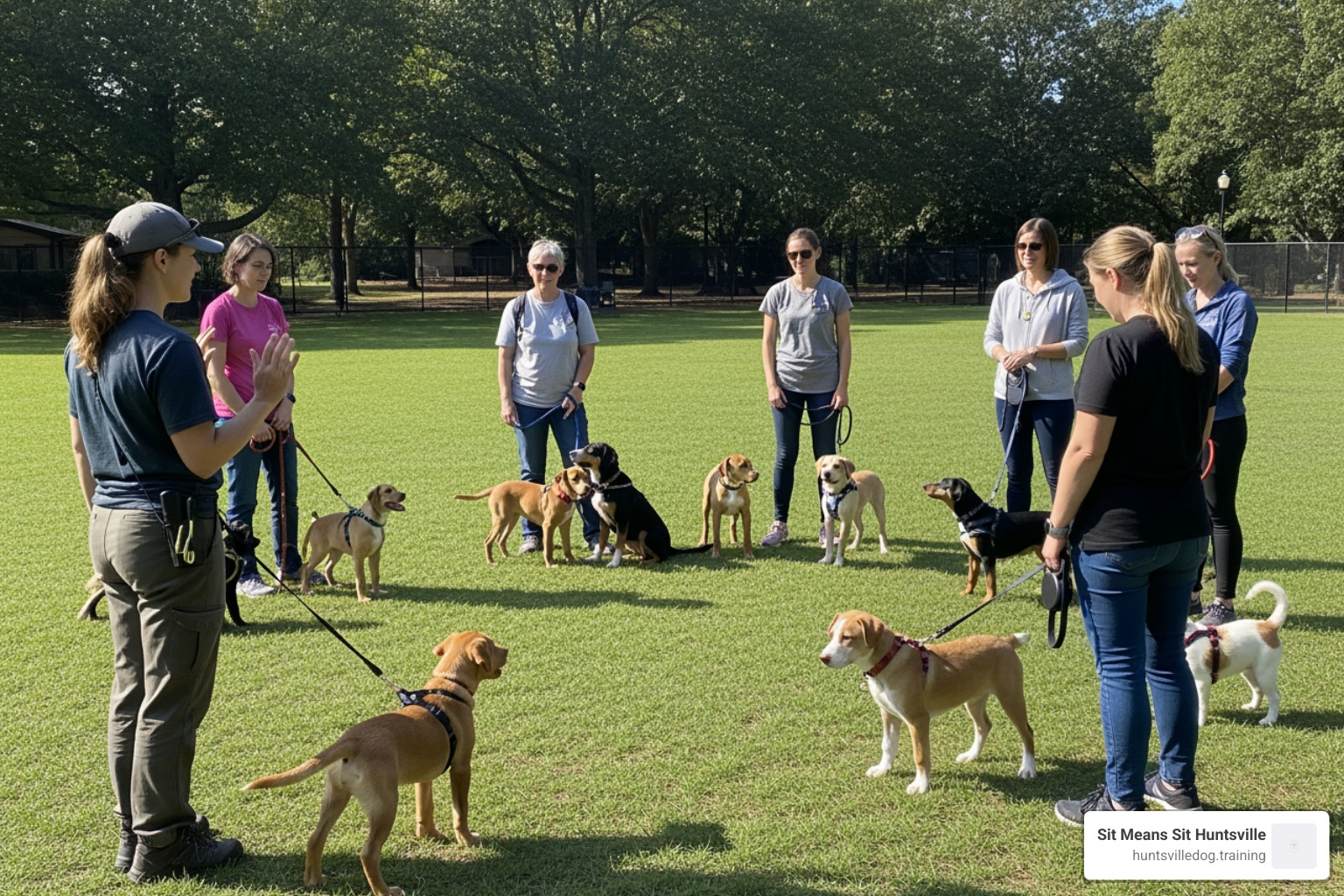
Group puppy training classes are the ultimate “classroom” for learning how to listen in a crowd. In a group setting, your puppy is exposed to other dogs, different people, and a variety of sounds and movements. This environment is essential for building environmental neutrality.
The goal isn’t for your puppy to play with every dog they see, but rather to learn that they can be in the presence of distractions and still look to you for guidance. Our instructors maintain strict safety protocols, often requiring a minimum of three feet of space between dogs to ensure a focused and safe learning environment. For a deeper dive into mastering these settings, see our group training 101 guide.
Tailored Results with Intensive Private Puppy Training Classes
While group classes are great for general distractions, intensive private puppy training classes offer accelerated learning and individualized attention. If your puppy has a unique temperament—perhaps they are particularly fearful or unusually high-energy—private sessions allow us to tailor the movement and body language cues specifically to them.
Intensive private training is also the best way to tackle “in-home” problems that don’t always manifest in a classroom, such as door-rushing or backyard digging. Our trainers act as coaches, helping you refine your own handling skills so that the communication between you and your puppy is crystal clear. Discover more about our North Alabama puppy training services to see which path fits your lifestyle.
The Huntsville Dog Training Method: Communication Through Movement
At Huntsville Dog Training, we do things differently. Our balanced training philosophy is built on proactive, handler-led guidance focusing on real-world reliability. We use movement and body language to communicate with the dog in a way they instinctively understand.
Our trainers, many of whom come from rigorous military backgrounds, focus on clear communication. We use flat collars and leashes as our primary tools, emphasizing how the handler’s position and movement can guide a puppy into the desired behavior.
As the puppy matures, typically around 4 months of age, we introduce “remote touch” (e-collars) as a subtle communication tool. This isn’t about punishment; it’s about having a “long-distance leash” that allows us to proof behaviors at a distance and ensure off-leash reliability. This method provides the dog with total clarity and the owner with unwavering confidence. Learn more about our dog training group classes in Huntsville to see this method in action.
Rapid Results: Day Train and Board & Train Programs
We know that modern families in Huntsville, Madison, and Decatur are busy. You want results, and you want them fast. That’s why our most popular options are our immersive programs:
- Day Train (Very Fast): Your puppy spends the day with our professional trainers, receiving multiple focused sessions throughout the day. You drop them off in the morning and pick them up in the evening, seeing progress almost immediately.
- Board and Train (Fast): This is our 5-day intensive program. Your puppy stays with us, allowing for 24/7 consistency and habit reshaping.
Proactive clients typically see major changes within Week 1. We start collar training at 4 months, and by 5-6 months, we are working toward full off-leash reliability. These training programs are designed to turn your chaotic puppy into a reliable companion in record time.
Essential Requirements and Safety Protocols
To participate in our puppy training classes, we prioritize the health and safety of all participants. Before starting any active drills, we require a vet health check to ensure your puppy is physically ready for the movement-based training we provide.
Vaccination Requirements:
- Distemper/Parvo: Puppies must have at least one set of vaccinations administered at least 7 days prior to their first class.
- Rabies: Required for all puppies 16 weeks and older.
- Bordetella: Highly recommended for all group settings.
We maintain strict safety protocols, including controlled spacing between dogs, to prevent disease transmission and ensure that every puppy has a positive, stress-free experience.
Frequently Asked Questions
At what age should my puppy start professional training?
We recommend starting simple foundational training as soon as you bring your puppy home, usually around 8 weeks. Professional group classes or private sessions typically begin between 8 and 16 weeks of age. The earlier you start, the easier it is to prevent bad habits from forming.
What are the most common behavior challenges addressed?
Our puppy training classes tackle the “big four” that most owners struggle with: biting/nipping, jumping on guests, potty training, and leash pulling. We also focus on building confidence to prevent future issues like fear or reactivity.
How do Day Train programs differ from Board and Train?
Day Train is a “commuter” program where the puppy goes home with you every night, making it a great middle-ground for owners who want professional help but want their pup home in the evenings. Board and Train is a 5-day immersion that provides the most rapid results by removing the puppy from their home environment where bad habits may be triggered, allowing us to reset their behavior completely. Crate training is provided only as support for clients enrolled in a training program.
Conclusion
Transitioning from a chaotic puppy to a reliable canine citizen doesn’t happen by accident. It requires a structured approach, clear communication, and the right environment. Whether you choose the social atmosphere of our group puppy training classes or the intensive, rapid results of our Day Train and Board & Train programs, Huntsville Dog Training is here to guide you.
Serving Huntsville, Madison, Decatur, and the surrounding North Alabama communities, we focus on proactive, handler-led guidance that builds a lifelong bond based on trust and movement. Ready to see the difference clear communication can make? Schedule your puppy training program today and start your journey toward a well-behaved, confident dog.